
Understanding Hobby Pricing Levers


Whether you’re new to the hobby or a seasoned vet, it’s important to understand all of the things that can affect the price of cards. Knowing about these levers and how to leverage them will be key to ensuring your hobby experience is both fun and profitable.
The hobby is a living, breathing thing, which is why it can be so unpredictable. Nothing is for certain in cards, since we’re dealing with individual persons, teams and leagues, as well as market and cultural conditions that could go up, down, or sideways on any given day. Like the stock market, understanding all of the elements that can drive prices up or down and learning to get ahead of them is how one thrives in such a broad and complex industry.
It can be a lot to look at all of these factors at once and to try and see the big picture in your head, so let’s break them down into more easily digestible portions; timing, market conditions, player context, and card context.
Timing
As with most things in life, timing is everything, but it’s especially important with cards. What’s valuable one day may not be in a few weeks or months.
Let’s start with the big picture and look at annual trends and how seasonality can help you plan on when to buy and sell. Generally speaking, prices for sports and their athletes start building momentum as the season is approaching; think 1-2 months leading up to opening day. Those prices usually peak around opening day since everyone has hype, and no one has underperformed yet. Don’t worry, most players will begin to underperform quite quickly, and their prices will go down. A few players will deliver on expectations and should go up, until they stop performing well and they too go down. The rare few who perform well throughout the season (what up PCA!), well, their prices will skyrocket…then go down in the offseason. The extremely rare few who consistently produce each season, well, there is no offseason because they’ve already set their floor.
Once the regular season has ended, anyone NOT in the playoffs will go down until the next cycle begins as described above. Same with players on teams that get knocked out of the playoffs; hope you cashed out before then, because their prices will likely dip until next season is within sight. GOATs like Shohei and Jordan have their floors, so there really is no offseason with them. That’s the rarest of cases, though, so unless you’re dealing in GOATs, be ready for those seasonal fluctuations.
There are nuances between each sport as well, but generally speaking, the same annual fluctuations are pretty reliable.
Also generally speaking, a player’s prices will likely never be higher than just after they get called-up to the Majors, upgraded to starter, etc. So much hope that is rarely delivered upon. Cash out at the call up!
Same goes with sealed wax. Prices for cards from new products are usually the highest just after the product is released, and then prices begin to gradually go down as more cards hit the market, and other products are released and grab the market’s attention.
All of this happens every year, so really get to know these somewhat predictable trends and base your buying/selling activities around the best time to act.
*Notice the peak at launch, the next peak near Opening Day 2025, and the rise in 2026 as PCA marched towards the MVP.

Market Conditions
While it would be nice to gauge card values only on player performance, life ain’t that simple, and aspects outside of the sport can impact card values just as much as what the athletes do on the field/court/pitch.
The first and most recent example is the PSA (and grading overall) shutdown. Their backlog got up over 12MM cards, so they closed all Value levels, forcing folks to pay a minimum of $80 to get a card graded. Value is back at $40, so we’ll see if/how that brings folks back into the fold. Regardless, goes to show that a corner of the market can shut off at any point, so you need to be ready for anything.
On that note, what TCG does has proven to impact sports collectors as well. The PSA shutdown was basically caused by so many Pokemon cards being submitted, so don’t ignore what our friends at those tables are doing these days.
Aside from the card market, there’s also the leagues to consider. Players can’t play if the owners and PAs can’t agree on collective bargaining agreements. Case in point, the looming MLB lockout in 2027. Will there be games at all? Will we just miss a few? Will the full season happen? We don’t know, and that’s adding stress on buyers who are shielding themselves from possible effects. We don’t know whether there will be games, whether prices will drop if there are no games like in 1994, or if they’ll actually go up like they did during covid. That uncertainty is slowing the market down, but how slow will it go? We just don’t know.
How is the national economy doing? The global economy? These statuses will determine whether folks have money to spend or not. That’s a huge pipeline that can also impact card prices. One national/global tragedy could freeze spending at the drop of a hat. Again, prepare yourself so that you’re not surprised if/when something like this happens.
*When Geoff is pumping an idea or card, you know it’s reached max hype.

Player-level Context
As previously mentioned, players’ performance definitely impacts the value of their cards, but there’s more about the player that impacts pricing. Let’s review a few ways…
Team performance can be just as important as how a player does. If a team does well and makes a deep run through the playoffs, players on those teams will get a boost. If the team sucks, the player will have to be a badass to outshine their teammates, despite being on a loser.
As mentioned before, most players’ values are the highest they’ll ever be right when they either get called up or become a starter for the first time. Lots of hype around this time frame, hype that isn’t guaranteed to last very long.
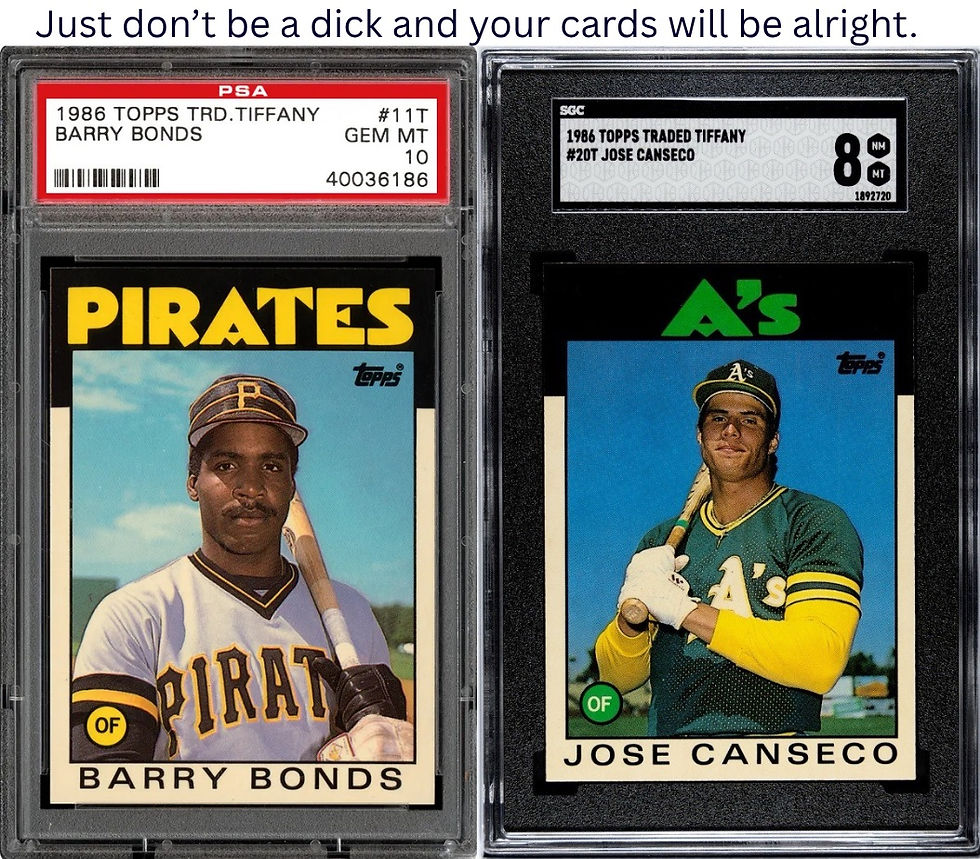
Is the player likeable? Is their personality just as investable as their performance? Do they have that certain je ne sais quoi? If so, these lovable figures could get a boost. If they’re not likeable (aka Barry Bonds, Kevin Durant, Aaron Rodgers, etc.), they likely have a ceiling of how high they can go.
Injuries, oh injuries. How you ruin our fun. The NFL is going through an epidemic of injuries right now that is crushing excitement for the season and for those injured players’ cards. Crushing when it happens, but it can happen any day, so be ready for whatever may happen. TCG folks don’t have to worry about this. Lucky ducks.
Players can also be idiots off the field/court and impact their playing availability. Hope you didn’t have any Ray Rice cards.
Lastly, and most certainly the saddest of the aspects that can impact their pricing, is the player’s race/nationality. America still loves its golden boy white quarterbacks, but not necessarily the incredibly talented player from another country that doesn’t look like them. I’ve discussed this with other dealers recently, and the sad fact is that race and nationality do impact pricing in the US, so be cautious before investing in folks like Jackson Chourio and Junior Caminero, because even though they’re two of the brightest up and coming stars, and they both just made/won the World Series, their prices haven’t seen a tremendous impact. Yet have you seen their prices jump like they did for PCA, who got knocked out in the first round the playoffs? Didn’t think so. Again, sad but true, so plan accordingly.
Card-level Context
This is the most straightforward and predictable category because it doesn’t involve micro details like players or leagues. We know the card manufacturers, the brands that they produce, and how the market feels about each of those brands. Flagship products will always be desirable, high-end products will always have their deep pocket buyers, and we know what sub-brands folks actually care about or not. Let’s break it down even more…
What year is the card?
A desirable year is defined mostly by its rookie class. Occasionally sets will get boosted by rad inserts, special vet chases, etc., yet the set of rookies in that release will dictate whether the hobby chases it or not.
What brand is the card?
Every collector is going to have their own subjective opinion about which brands they prefer the best, yet there is a hobby consensus of which brands hold their value best. Most products are exciting upon release; a cool new look with a new crop of players. That’s the lust phase of ripping wax. Then reality sets in…
Flagship brands (Topps, Topps Chrome, etc.) and their offshoots seem to hold their value best, while sub-brands (Finest, Resurgence, etc.) start strong but don’t maintain long-term value in the eyes of buyers. They’re onto the next release before you know it. Make sure you know the difference between brands before investing. It’s better to be targeted with your buys vs. broadly taking a stab with every brand.
What is the print run?
The hobby will never live down the junk wax period of the mid-80s to early 90s. Massively over-printed products that diluted any possible long-term value for anything other than the ‘89 Upper Deck Griffey and a couple other GOAT rookies. When there are millions of copies of each card, there’s not going to be demand. In turn, no value.
Manufacturers learned their lessons from the junk wax 1.0 period, cutting down on print runs and adding parallels, autographs, memorabilia, and other special inserts to add way more value than the base sets of the 80s and prior. Since the covid boom, actually since around when Judge and Shohei showed up in ‘17-’18, print runs have gotten more out of hand than the previous couple decades, but nowhere near as bad as the original junk wax run. Regardless, each product/set/year has its own level of rarity, so be sure to know how much of the product is being released. Flagship products like Topps are intentionally printed to the moon so that more people can get their hands on it. Later releases such as Sapphire have a much smaller checklist and are printed much less, in turn increasing its rarity, desirability, and value. Know the difference before spending any money.
In what condition is the card?
This one is easy. There are 4 main areas to review to determine a card’s condition.
Are the corners sharp?
Are the edges clean?
Is the surface without imperfections?
How is the centering? Is it heavy left/right/top/bottom?
Grading helps alleviate any question about the condition of a card, but that’s not even a perfect solution. Unless you go with BGS or another company that can give you sub-grades on these 4 points, you won’t get any transparency about why your card got a certain grade from PSA. Just the grade. It’s infuriating to not have that level of detail aside from the grade, but that’s the way it is folks, so make sure you look at the actual card to fully understand what you’re dealing with.
Is the card graded?
Speaking of grading, it is by far the biggest change in the industry from when we used to collect before the internet. If a card is graded, one knows the card is legit and what condition it’s in. If it’s not graded, one can’t know about any flaws unless they have it in-hand, which rarely happens these days with so much transacting digitally/remotely. Graded cards make transacting so much more seamless because there isn’t all of that doubt, only certainty. Well, as much as they can provide.
It’s still TBD on if/how the grading company shutdowns will impact whether people buy graded vs. raw. Either way, it’s a pillar of the hobby that isn’t going anywhere. While grading can drastically improve a card’s value, all of that time and money spent to get a card graded may not make up for the lost earning potential of selling asap. To grade or not to grade? Take the money and run or wait for the potential of more? Is a bird in hand worth two in the bush for you? Time to decide for yourself.

What is the pop count?
Within the world of grading, it’s important to know how many of a card has been graded, and how many of each grade exist. We call this the “pop count” as in population. The lower the pop count, the more rare the graded card is, the more valuable it is. The higher the pop count, the less rare the graded card is, limiting its potential value. Some players/cards buck this trend, like Shohei having almost 12,000 PSA 10s of his rookie Topps paper card and still being highly sought after. Yet even that has its downfalls because these high pop count cards will always be the first to dip, a lot, when contractions hit the market. This is currently happening with his cards; the rare stuff is holding strong, but the more common base cards have taken a big hit, because there are so many of them. Just one example of why pop counts are so important to understand.
Is the card modern or vintage?
We could dive deeep into this one, but to keep it simple…
Vintage card values are more stable because the players are no longer playing, and no longer able to impact values up or down based on performance and other on/off the field actions.
Modern cards are riskier because players are still active and so many variables, as discussed above, can still drive their prices up or down. Less stable, but still with a higher ceiling potential.
Is the card licensed vs. unlicensed?
Last but certainly not least is knowing whether the card/set is licensed by the league’s players’ association or not. This determines whether the team logos and names can be displayed on the cards. Licensed brands will have logos/names, while unlicensed cards have no logos/names and usually just show a blank jersey/helmet.
Most folks I know really don’t like unlicensed cards, while some folks don’t care about the lack of logos and use that as a buy-low opportunity. It’s up to you, but I will say, unlicensed card values are customarily much lower than licensed, so keep that in mind when buying.
There you go folks. So much to know to stay up to speed in the hobby these days. I know it’s a lot, so please comment with any questions you have or anything I missed. We’ll keep this article updated with your insights, so bring them on!
Thanks and happy collecting!
Craig/Xennial



Comments